Ask about the two-stage matcher, fit dimensions, resume pipeline, or split-database design. I answer from project docs.
MatchPoint
AI job matcher that ingests 5,867 live roles from 70 Greenhouse boards, retrieves candidates with a precomputed embedding matrix, then scores fit with structured LLM output grounded in job facts.
React 19FastAPIOpenAITursoSupabaseVercel
MatchPoint
Live jobs
5,867
Greenhouse boards
70
Fit dimensions
8
Embedding dim
1536
Vector search
<10ms
Ingest cadence
Daily
As of 2026-07-02
Ask the Data
This assistant answers from MatchPoint documentation on this site: ingestion cadence, the two-stage matcher, split-database design, and resume pipeline.
MatchPoint Chat
Documentation-backed answers on ingestion, matching, and architecture.
Key Performance Indicators
Live product
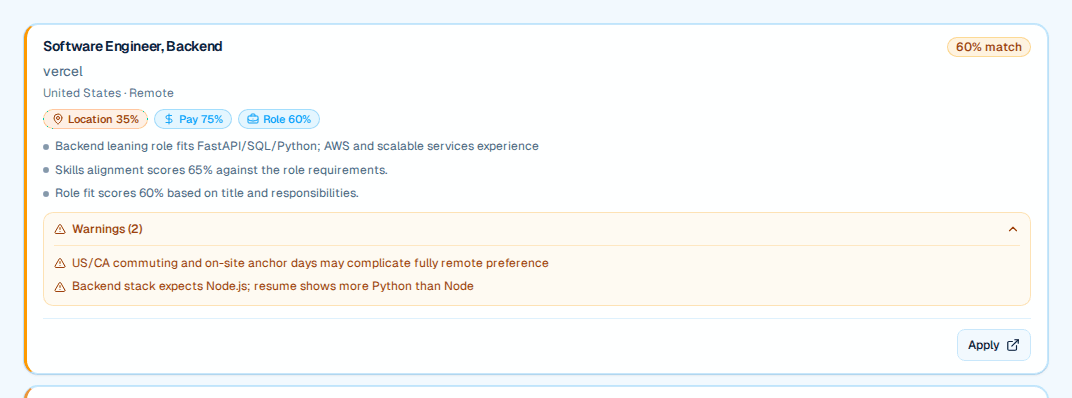
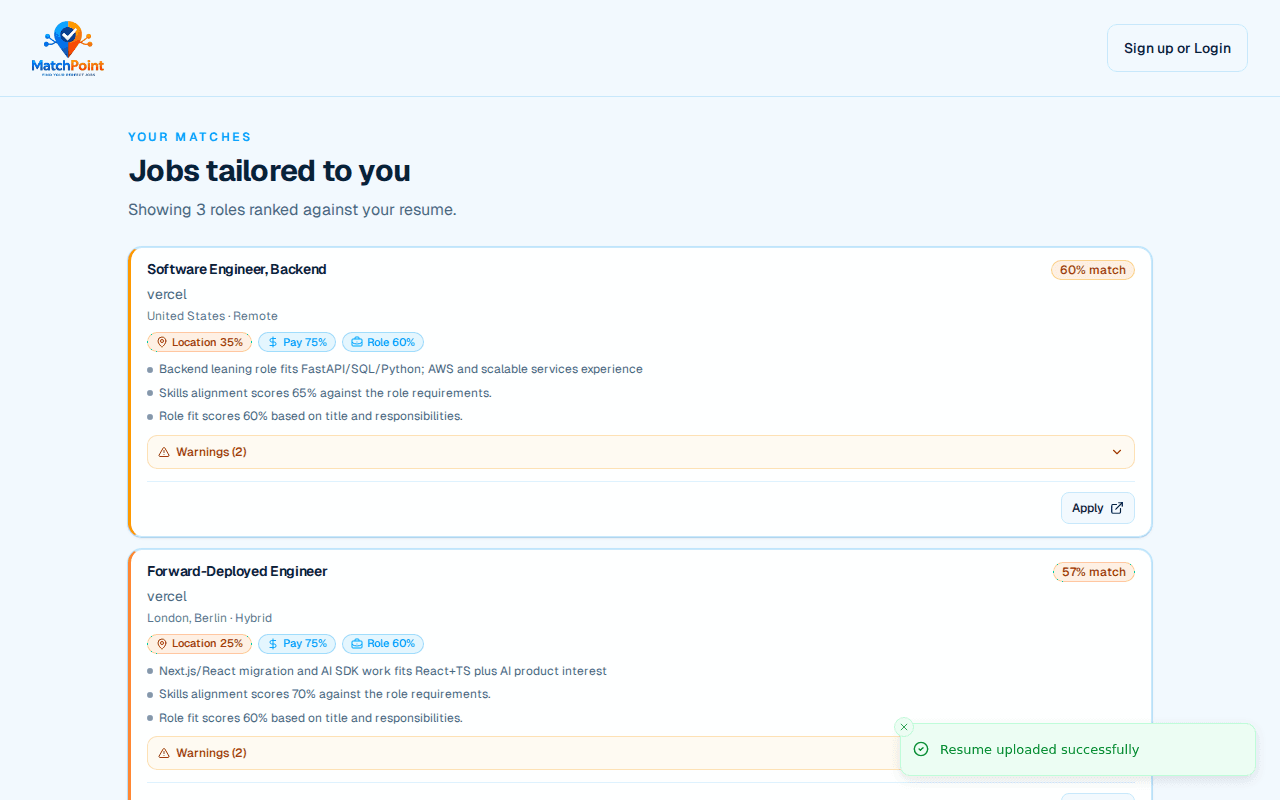
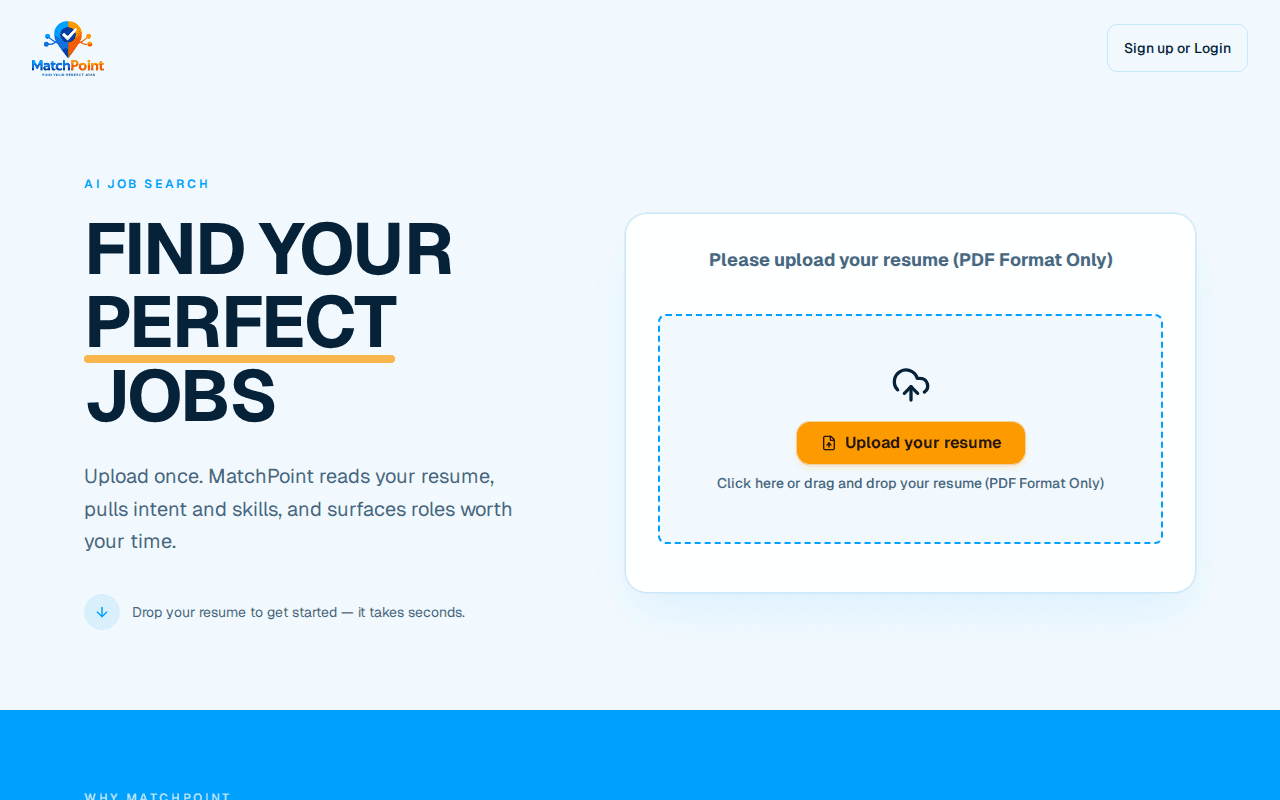
Upload a resume, get ranked matches with grounded highlights, and explore fit signals across eight weighted dimensions. Anonymous visitors see a 3-match preview before signup.
Try MatchPointSplit-database design
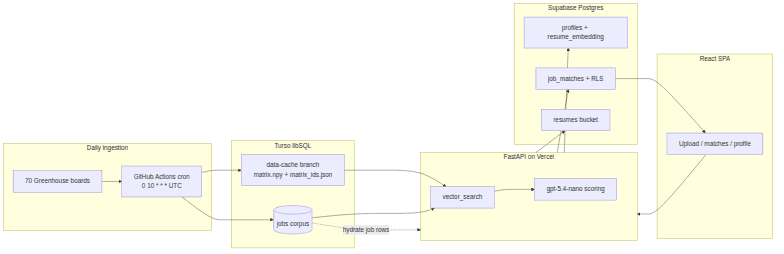
Jobs live in Turso (libSQL) for fast vector retrieval at scale. User state — profiles, matches, saved jobs, resume storage — lives in MatchPoint's own Supabase project with RLS. The FK between job matches and the Turso corpus was dropped intentionally; orphaned matches hydrate from Turso at read time.
Turso jobs corpus
Up to 5,867 live jobs from 70 Greenhouse boards. HTML stripped, embedded with OpenAI text-embedding-3-small (1536-dim). Jobs unseen for 7 days are purged.
Supabase user state
Auth, profiles, job_matches, resume storage bucket, and pgvector resume embeddings on profiles.resume_embedding.
Two-stage matching
1. Vector retrieval
Resume embedding queries a precomputed L2-normalized NumPy matrix (~33 MB) published to a data-cache git branch for warm sub-10ms search on Vercel serverless. Top 10 candidates for signed-in users; top 3 for anonymous visitors.
2. LLM scoring
gpt-5.4-nano structured output scores each candidate across eight fit dimensions, producing a weighted match_score, exactly three grounded highlights with citation quotes, and optional warnings.
| Fit dimension | Weight |
|---|---|
| Skills overlap | 25% |
| Experience fit | 18% |
| Role alignment | 17% |
| Seniority match | 10% |
| Location | 10% |
| Compensation | 7.5% |
| Preferences | 7.5% |
| Interview likelihood | 5% |
Resume pipeline
Upload → extract → embed
PDF upload → pypdf text extraction → embedding stored on profiles.resume_embedding.
Match persistence
Matches persisted via a replace_job_matches RPC. Extras: resume skill suggestions and an LLM bullet coach on gpt-4o-mini.
Daily ingestion
GitHub Actions runs daily at 10:00 UTC: scrape up to 100 jobs per board across 70 Greenhouse companies (Stripe, Airbnb, Anthropic, Databricks, GitLab, …), embed new/changed rows, upsert to Turso, purge stale jobs, and force-push the embedding matrix to the data-cache branch.
.github/workflows/daily-pipeline.yml
schedule:
  - cron: "0 10 * * *"  # 10:00 UTC daily

steps:
  - scrape 70 Greenhouse boards (≤100 jobs each)
  - strip HTML, embed with text-embedding-3-small
  - upsert to Turso jobs table
  - purge jobs unseen for 7 days
  - publish L2-normalized embedding matrix → data-cache branch
Grounded output
Every highlight cites a verbatim quote from the job posting. The scorer receives structured job facts (title, requirements, location, comp when available) and must not invent qualifications. Warnings surface mismatches (seniority gap, location conflict, missing must-have skills).